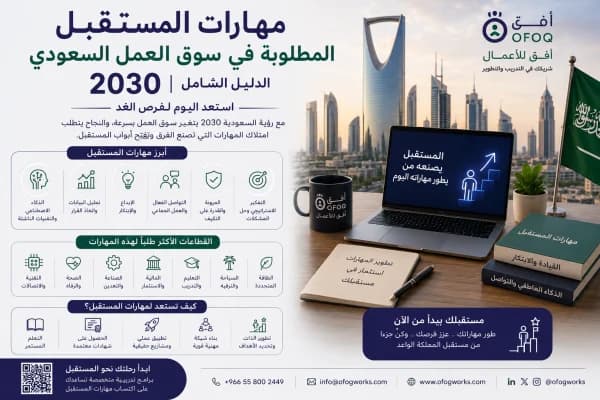
Future Skills Required in the Saudi Job Market 2030: Your Complete Guide to Staying Ahead of the Competition
A comprehensive guide exploring the most in-demand skills in the Saudi job market by 2030, backed by the latest global and local studies, with practical strategies to acquire them and excel in the era of Saudi Vision 2030.
Future skills are a set of cognitive, technical, and behavioral competencies that the Saudi job market will require by 2030 to keep pace with major economic and technological transformations. According to the World Economic Forum, 10 core skills will dominate the future of work, led by analytical thinking and innovation, complex problem-solving, and resilience and adaptability [3]. In Saudi Arabia, Vision 2030 is driving an unprecedented transformation toward a knowledge-based economy, creating growing demand for skills such as artificial intelligence, data analytics, digital leadership, and advanced soft skills. Investing in developing these skills today is not an option but a strategic necessity to ensure career sustainability and competitiveness in tomorrow's job market.
In a world changing at an unprecedented pace, where technological innovation accelerates and business models undergo radical transformation, the most important question facing every employee, every leader, and every organization in Saudi Arabia is: What skills will you need tomorrow to stay ahead of the competition?
As we approach the halfway mark toward achieving Saudi Vision 2030, the transformation from an oil-based economy to a diversified knowledge economy is accelerating, creating immense opportunities and new challenges alike. In this comprehensive guide, we explore the skills that will dominate the Saudi job market by 2030, drawing on the latest global studies and expert analyses, and provide you with a practical roadmap to acquire them and excel.
📌 Quick Summary: Future Skills in the Saudi Job Market 2030
- 🧠 Cognitive Skills: Analytical thinking, complex problem-solving, creativity and innovation
- 💻 Technical Skills: Artificial intelligence, data analytics, cybersecurity, programming
- 🤝 Behavioral (Soft) Skills: Leadership, emotional intelligence, resilience, effective communication
- 📊 Managerial Skills: Project management, strategic thinking, change management
- 🇸🇦 Saudi Context: Vision 2030 creates specific demand for skills in digital transformation, renewable energy, tourism, and logistics [4]
- 🎯 The Bottom Line: Investing in these skills today is the key to professional success tomorrow
Why Future Skills? What is the Future of Work?
The world of work is changing faster than we imagine. The World Economic Forum estimates that 85% of the jobs that people will be doing in 2030 haven't been invented yet [2]. This means that the skills we learn today may not be sufficient for the jobs we will practice tomorrow. At the same time, studies indicate that 66% of jobs will require advanced digital skills by 2030 [1].
A recent McKinsey study projects that up to 30% of global work hours could be automated by 2030, meaning routine and repetitive tasks will become the domain of machines, while creativity, critical thinking, human interaction, and leadership will remain the domain of humans [5].
In this context, future skills become not just a competitive advantage but a fundamental requirement for survival and prosperity in the changing job market.
Top 10 Most In-Demand Skills in the Job Market 2030
According to the World Economic Forum report [3], these are the top 10 skills that will dominate the job market by 2030:
Analytical Thinking & Innovation
The ability to analyze complex information, extract insights, and generate new ideas and innovative solutions to problems.
Complex Problem Solving
The ability to deal with unfamiliar and complex problems that require multi-dimensional thinking and innovative solutions.
Resilience, Flexibility & Agility
The ability to adapt to rapid changes, recover from setbacks, and adjust to changing environments.
Curiosity & Lifelong Learning
Continuous motivation to learn and acquire new skills, and the ability to keep pace with rapid developments.
Emotional Intelligence
The ability to understand and manage personal emotions, empathize with others, and build effective relationships.
Critical Thinking
The ability to evaluate information objectively, analyze arguments, and make informed decisions.
Leadership & Social Influence
The ability to inspire and motivate others, lead teams, and positively influence those around you.
Technology & AI Management
Understanding how to strategically use technology and artificial intelligence to achieve business goals.
Global & Cultural Awareness
Understanding different cultural contexts and working effectively in multicultural environments.
Data Analysis & Data-Driven Decision Making
The ability to collect and analyze data and use it to support strategic decision-making.
To learn more about in-demand professional specializations in Saudi Arabia, check out The Essential Guide to the Most In-Demand Professional Specializations in Saudi Arabia.
🇸🇦 Future Skills in the Saudi Context and Vision 2030
Saudi Vision 2030 is not just an economic plan; it is a roadmap for transforming the Kingdom into a diverse and sustainable knowledge economy. This transformation creates specific demand for a set of skills that align with the Vision's goals in particular sectors [4]:
Digital Transformation & AI
AI, machine learning, big data analytics, and cybersecurity skills are most in demand amid the digitization of government and private sectors.
Tourism & Entertainment
With projects like the Red Sea and Qiddiya launching, demand is growing for hospitality, event management, tourism marketing, and logistics skills.
Renewable Energy & Sustainability
The shift toward clean energy creates demand for environmental engineering, energy management, and sustainability technology skills.
Logistics & Supply Chains
The Kingdom's strategic position as a global logistics hub creates demand for supply chain management, e-commerce, and smart logistics skills.
The Ministry of Human Resources and Social Development emphasizes the importance of "developing digital and leadership skills for national talent" as one of the pillars of the Human Capability Development Program [6].
Most In-Demand Digital and Technical Skills
Studies indicate that 66% of jobs will require advanced digital skills by 2030 [1]. Here are the most in-demand digital skills:
| Skill | Description | Most In-Demand Sectors |
|---|---|---|
| Artificial Intelligence & Machine Learning | Developing and applying AI algorithms to solve business problems | Technology, Finance, Healthcare, Oil & Gas |
| Data Analytics & Big Data | Collecting, analyzing, and interpreting data for strategic decisions | All sectors |
| Cybersecurity | Protecting systems, networks, and data from cyberattacks | All sectors, especially Government & Finance |
| Cloud Computing | Designing and managing cloud infrastructure and applications | Technology, Financial Services, Government |
| Programming & Application Development | Designing and developing web and mobile applications | All sectors |
| Blockchain Technology | Developing and applying distributed ledger technologies | Finance, Logistics, Government |
| Internet of Things (IoT) | Connecting devices and systems to collect and analyze data | Industry, Energy, Transportation, Smart Cities |
Soft Skills: Leadership and Emotional Intelligence at the Forefront
With the increase in automation and AI, soft skills become more valuable than ever. These skills are what distinguish humans from machines and will remain in high demand in the future [3].
Emotional Intelligence (EQ)
The ability to understand and manage personal emotions and empathize with others. Essential for leadership and relationship building.
Effective Communication
The ability to express ideas clearly, listen actively, and communicate with diverse audiences.
Teamwork & Collaboration
The ability to work effectively within diverse teams and contribute to achieving shared goals.
Resilience & Adaptability
Dealing with changes and challenges flexibly, and learning from mistakes and setbacks.
Creativity & Innovative Thinking
The ability to generate new ideas, think outside the box, and find innovative solutions.
Time Management & Organization
The ability to organize tasks, set priorities, and manage time effectively in a fast-paced work environment.
To learn more about the importance of soft skills in the Saudi job market, check out our article: Soft Skills in the Saudi Job Market 2026.
How to Acquire Future Skills? Practical Strategies
Here are 5 practical strategies to develop future skills and stay ahead of the competition:
Sustainable & Continuous Learning
Dedicate weekly time to learning. Leverage educational platforms, training programs, and open resources. Regularly update your knowledge in your field and new areas.
Enroll in Accredited Training Programs
Join professional master's programs, professional doctorates, and specialized diplomas offered by internationally accredited institutions like Cambridge British College through Ofoq Academy.
Practical Application & Real Projects
Don't just learn theory; apply what you learn in practical projects, whether in your current job or through personal projects. This enhances understanding and builds a strong portfolio.
Build a Strong Professional Network
Connect with experts in your field, join professional communities, and participate in conferences and seminars. Professional networks are valuable sources of learning and opportunities.
Seek Feedback & Self-Development
Seek feedback from colleagues and managers, identify your strengths and weaknesses, and work on developing them systematically.
Ofoq Academy: Your Partner in Developing Future Skills
Ofoq Academy offers professional master's programs, professional doctorates, and specialized diplomas in the most in-demand specializations in the Saudi and global job markets, in partnership with Cambridge British College.
- 🎓 Internationally Accredited Programs covering: Business Administration, Governance, Cybersecurity, Artificial Intelligence, Human Resources, Project Management, HSE, and Supply Chains
- 🏅 Globally Recognized Certificates from Cambridge British College
- 🎥 Flexible Learning Experience combining live lectures, recordings, and interactive engagement
- 💳 Financial Flexibility with installment plans up to 6 months with no interest
- 🇸🇦 Full Alignment with Saudi Vision 2030 and local job market needs
📜 International Accreditation Numbers:
• UK Government Accreditation Number: 15970031
• UKPRN: 10096906
• ICO: ZB785122
To learn more about available programs and how to enroll, visit our Programs page, or check out The Complete Guide to Distance Learning at Ofoq Academy.
Frequently Asked Questions About Future Skills in Saudi Arabia
📌 What are the most in-demand skills in the Saudi job market 2030?
The most in-demand skills include: analytical thinking and innovation, complex problem-solving, emotional intelligence, leadership, digital skills (AI, data analytics, cybersecurity), and resilience and adaptability [3].
📌 How do future skills connect to Vision 2030?
Vision 2030 aims to transform the Kingdom into a diversified knowledge economy, creating demand for skills in digital transformation, tourism, renewable energy, and logistics. The Human Capability Development Program focuses on developing digital and leadership skills for national talent [4][6].
📌 What are the best ways to develop future skills?
The best ways include: enrolling in professional master's programs and specialized diplomas, self-learning through educational platforms, practical application through real projects, building a professional network, and seeking continuous feedback.
📌 Are soft skills really important for the future?
Yes, soft skills such as emotional intelligence, leadership, and effective communication will become even more important in the future with the increase in automation and AI. These skills are what distinguish humans from machines and will remain in high demand [3].
📌 How can I start developing future skills today?
You can start by: identifying the skills required in your field, searching for accredited training programs (like those offered by Ofoq Academy), dedicating weekly time for learning, and joining professional communities to learn from experts and share knowledge.
🚀 Invest in Your Professional Future Today
With Ofoq Academy, you can develop the skills you will need in tomorrow's job market. Our internationally accredited programs from Cambridge British College give you the competitive edge you need to excel in your professional journey.
✉️ Response within minutes – Free consultation with no obligation
📚 Sources & References
- [1] World Economic Forum – The Future of Jobs Report 2025
- [2] Dell Technologies – The Next Era of Human-Machine Partnerships 2020
- [3] World Economic Forum – Future of Jobs Report: Top 10 Skills 2030
- [4] Saudi Vision 2030 – Human Capability Development Program
- [5] McKinsey – The future of work after COVID-19
- [6] Ministry of Human Resources and Social Development – Human Capability Development Program
- [7] LinkedIn – Most In-Demand Skills 2025
- [8] Forbes – The 10 Most Important Skills For The Future Of Work
Written by
Moosa Amsabh
خبير ومستشار مهني في أكاديمية أفق ، حاصل على درجة الماجستير في إدارة الأعمال من كلية كامبريدج. اعمل حالياً على إعداد وتطوير مساقات مهنية معتمدة دوليا تهدف إلى تمكين الكوادر الوطنية السعودية
Discussion
0 comments
Join the Conversation
Sign in to share your perspective and engage with the Jadeer Platform (Ofoq Academy) community.
Sign In to Participate