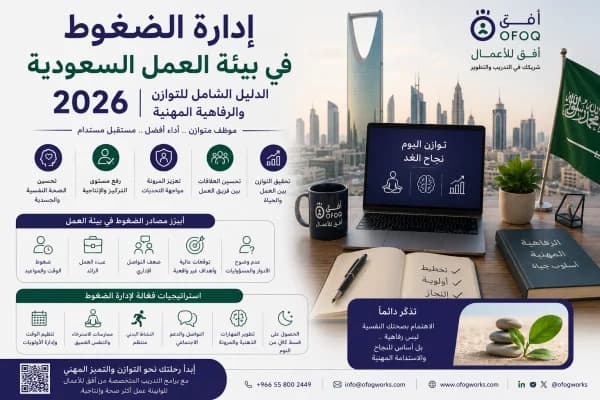
Stress Management in the Saudi Workplace 2026: Your Complete Guide to Balance and Professional Well-being
A comprehensive guide exploring the reality of workplace stress in Saudi Arabia, its causes, impact on performance and mental health, and the most effective practical strategies for managing stress and achieving work-life balance under Vision 2030.
Workplace stress management is a set of strategies and practices aimed at identifying sources of occupational stress, understanding their impacts, and effectively coping with them to maintain mental and physical health while improving job performance. In Saudi Arabia, the latest data from the General Authority for Statistics shows that 6% of employees suffer from work-related stress, which ranks first among occupational health problems [2]. Gallup's report also reveals that 28% of employees in the Kingdom experience daily stress [1]. With the adoption of Vision 2030 and its goals for quality of life and health well-being [4], stress management has become a strategic necessity for both organizations and individuals alike, ensuring a productive and sustainable work environment.
Amidst the massive economic transformations taking place in the Kingdom of Saudi Arabia, and with the accelerating pace of work and rising expectations in the business environment, stress and psychological pressure have become an integral part of many employees' lives. Stress management is no longer just a personal skill; it has become an organizational necessity directly linked to productivity, retention, and quality of work life.
In this comprehensive guide, we explore the reality of workplace stress in Saudi Arabia with data, analyze its root causes, and provide practical strategies for managing it at both the individual and organizational levels, in alignment with the goals of Saudi Vision 2030 in building a vibrant society with a high quality of life [4].
📌 Quick Summary: Workplace Stress Management
- 📊 The Reality in Numbers: 28% of employees experience daily stress, 6% suffer from work-related tension [1][2]
- 🏛️ National Context: Vision 2030 places health and psychological well-being at the core of the Quality of Life program [4]
- 🧠 Key Causes: Multitasking, performance pressure, digital transformation, overtime work
- 🛠️ Individual Strategies: Time management, mindfulness, healthy sleep, regular exercise
- 🏢 Organizational Strategies: Employee Assistance Programs (EAPs), supportive work environments, leadership training
- 🎯 The Outcome: More productive employees, more cohesive teams, more sustainable organizations
What is Workplace Stress Management?
Workplace stress management is a set of skills, strategies, and practices aimed at identifying sources of occupational stress, understanding their effects, and effectively coping with them to maintain mental and physical health, improve job performance, and achieve balance between work demands and personal life.
Stress management does not mean eliminating stress entirely, as some levels of stress can be motivating and enhance productivity. The goal is rather to control stress levels and prevent them from becoming chronic, negatively affecting health and performance.
The Reality of Workplace Stress in Saudi Arabia by the Numbers
To understand the scale of the challenge, here are the key statistics that paint a picture of workplace stress in the Kingdom:
| Indicator | Percentage | Source |
|---|---|---|
| Employees experiencing daily work stress | 28% | Gallup Report 2026 [1] |
| Work-related stress (most common health issue) | 6% | General Authority for Statistics 2025 [2] |
| Employees suffering from burnout | 6.04% | General Authority for Statistics 2026 [5] |
| Employees who feel they are thriving | 51% | Gallup Report 2026 [3] |
| Employees experiencing daily sadness | 20% | Gallup Report 2026 [3] |
| Employees suffering from fatigue or overwork | 16.7% | General Authority for Statistics 2025 [2] |
Data from the General Authority for Statistics also shows that prolonged standing (25.3%) and fatigue or overwork (16.7%) are the most common workplace risks [2]. A previous study also found that 57% of employees believed that work stress had impacted their mental health [6].
🇸🇦 Vision 2030 and Stress Management: Quality of Life at the Heart of Work
Saudi Vision 2030 places quality of life and health well-being at the core of its objectives. The official Vision 2030 website states that "health, psychological, and social well-being are priorities of Saudi Vision 2030", and that at its heart is "ensuring everyone enjoys a high quality of life, a healthy lifestyle, and a thriving environment, building a vibrant society" [4].
The Quality of Life Program, one of Vision 2030's realization programs, works to encourage innovation, talent, and competencies to elevate the quality of life [7]. This includes improving work environments and making them more supportive of mental health and well-being.
The Ministry of Human Resources and Social Development has also launched initiatives to raise awareness about mental health, emphasizing the importance of "supporting human well-being and building more inclusive and balanced environments" [8].
Top Causes of Stress in the Saudi Workplace
Stress in the workplace comes from multiple sources, which can be categorized into several main types [9]:
Psychological Stress
Constant worry about performance, fear of negative evaluation, job insecurity, and pressure to achieve unrealistic goals.
Performance & Productivity Pressure
High productivity demands, multitasking, performance pressures, and rapid changes in work models [5].
Digital & Technological Transformation
Constant connectivity through apps, working outside official hours, and difficulty separating work from personal life.
Organizational Stress
Lack of managerial support, unclear roles and responsibilities, and poor inter-departmental communication.
Data shows that prolonged standing (25.3%) and fatigue or overwork (16.7%) are the most common workplace risks [2], reflecting the need to improve physical working conditions and distribute tasks more evenly.
The Impact of Stress on Performance and Mental Health
Chronic workplace stress has profound effects at both the individual and organizational levels:
🔴 Individual Impact
- Fatigue and burnout (6.04% of workers) [5]
- Psychological issues: anxiety, depression, sleep disorders
- Health problems: heart disease, high blood pressure, weakened immunity
- Declining performance and focus
- Reduced job satisfaction
Studies indicate that job stress is directly linked to decreased productivity, increased absenteeism, and rising healthcare costs, which directly impact organizational efficiency and human resource sustainability [5].
Effective Individual Strategies for Managing Stress
Here are 6 practical strategies every employee can apply to cope with workplace stress:
Time Management & Priority Setting
Use time management techniques like the Eisenhower Matrix to set priorities and avoid task overload. Schedule breaks between tasks.
Practice Mindfulness
Dedicate 5-10 minutes daily to meditation or deep breathing exercises. These practices help calm the mind and reduce stress [10].
Healthy Sleep & Balanced Nutrition
Aim for 7-8 hours of sleep per night and eat balanced meals rich in protein and vegetables. Avoid caffeine and sugars before bedtime.
Regular Exercise
Exercise is not just for the body, but also for the mind. 30 minutes of walking or jogging daily reduces stress levels and improves mood.
Set Boundaries Between Work and Life
Set a specific time to end work and avoid checking emails and work messages outside working hours. Learn to say "no" to unnecessary tasks.
Seek Support When Needed
Don't hesitate to seek support from colleagues, managers, or utilize available psychological counseling services. Removing the stigma around seeking help is essential [0].
The Role of Organizations and HR in Managing Stress
Employee mental health is no longer a luxury or a side issue in human resources; it has become a direct factor in productivity, retention, and workplace quality [6]. Here's what organizations can do:
✅ What Organizations Should Do
- Provide Employee Assistance Programs (EAPs) offering quick access to psychological counseling [0]
- Allocate budget for mental health support for employees [6]
- Provide insurance coverage for mental health [6]
- Train managers in supportive leadership and recognizing signs of burnout
- Encourage a culture of work-life separation and respect for rest periods
- Adopt flexible work policies (flexible hours, hybrid work)
❌ What to Avoid
- Sending work messages outside working hours
- Expecting immediate responses to emails during holidays
- Ignoring signs of burnout in employees
- A culture of physical presence as a productivity indicator
- Lack of clear policies for remote work
A recent study suggests that sustainable HR practices can alleviate work stress and enhance psychological well-being in the context of rapid digital transformation [11].
To learn more about corporate training programs in stress management, visit Ofoq for Business.
Ofoq Academy: Your Partner in Building a Healthy and Balanced Work Environment
Ofoq Academy offers specialized training programs in stress management, mental health in the workplace, and supportive leadership, in partnership with Cambridge British College. We aim to empower organizations and employees to build healthier, more productive work environments, aligned with Saudi Vision 2030 goals.
- 🏅 Internationally Accredited Programs from Cambridge British College
- 🎓 100% Applied Content based on the latest research in managerial psychology
- 👨🏫 Expert Trainers in mental health and stress management
- 🔄 Flexible Training Models (in-person, remote, blended) to suit your organization's needs
- 📊 Impact Measurement through clear performance indicators
📜 International Accreditation Numbers:
• UK Government Accreditation Number: 15970031
• UKPRN: 10096906
• ICO: ZB785122
For inquiries about stress management and organizational well-being programs, visit our Programs page or contact our team.
Frequently Asked Questions About Workplace Stress Management
📌 What are the most common causes of stress in the Saudi workplace?
The main causes include: high productivity demands, multitasking, performance pressure, digital transformation, overtime work, and constant worry about performance and evaluation [5][9].
📌 How can I tell if I'm suffering from chronic work stress?
Signs include: persistent fatigue, difficulty sleeping, lack of focus, irritability, reduced job satisfaction, and recurring health problems. If these symptoms persist, it is advisable to seek professional support.
📌 What is HR's role in managing workplace stress?
HR's role includes: providing Employee Assistance Programs (EAPs), allocating mental health budgets, training managers in supportive leadership, and adopting flexible work policies [0][6].
📌 How can training help with stress management?
Training helps employees identify stress sources, develop time management skills, mindfulness, and effective communication, enabling them to cope with stress more effectively and improve their job performance.
📌 How does stress management connect to Vision 2030?
Stress management is directly linked to the Quality of Life Program in Vision 2030, which aims to improve the well-being of citizens and residents, and build healthy, balanced work environments that support mental and physical health [4].
🚀 Invest in Your Team's Well-being.. Build a More Productive Organization
With Ofoq Academy, you can design specialized training programs in stress management and mental health, internationally accredited, and aligned with Saudi Vision 2030. Invest in your employees' well-being today, and reap tangible results in your organization's performance and productivity tomorrow.
✉️ Response within minutes – Free consultation with no obligation
📚 Sources & References
- [1] Gallup – State of the Global Workplace: Saudi Arabia Country-Level Data 2026
- [2] General Authority for Statistics – Health and Safety at Work Bulletin Results 2025
- [3] Gallup – State of the Global Workplace: Saudi Arabia Country-Level Data 2026
- [4] Saudi Vision 2030 – Vibrant Society / Quality of Life Program
- [5] Al-Watan Newspaper – 6.04% of workers suffer from burnout (April 28, 2026)
- [6] Saudi HR – Workplace Mental Health and Well-being in Saudi Arabia 2026
- [7] Saudi Vision 2030 – Quality of Life Program
- [8] Ministry of Human Resources and Social Development – World Mental Health Day 2026
- [9] Tawteen – Work Stress and Its Impact on Job Performance
- [10] MDPI – Stress-Management Interventions and Employee Well-Being 2026
- [11] Frontiers – The critical role of HR in managing stress and enhancing wellbeing 2026
خبير ومستشار مهني في أكاديمية أفق ، حاصل على درجة الماجستير في إدارة الأعمال من كلية كامبريدج. اعمل حالياً على إعداد وتطوير مساقات مهنية معتمدة دوليا تهدف إلى تمكين الكوادر الوطنية السعودية
Discussion
0 comments
Join the Conversation
Sign in to share your perspective and engage with the Jadeer Platform (Ofoq Academy) community.
Sign In to Participate